Not your ordinary panic button.
Go on. Press it.
See how Firefly would work in your hospital.
One press. Five things happen, quickly and in order.
Step 01 · Alert
Step 1. AlertThe press becomes a signal.
One tap on the wearable initiates an alert with a haptic confirmation on the device. The clinician knows it went through before they look down — even with hands full.- Step 02 · LocateStep 2. Locate
Down to the room, not the wing.
Firefly resolves position to the floor and room — not the unit or the building — using our proprietary mesh network. No external network required. 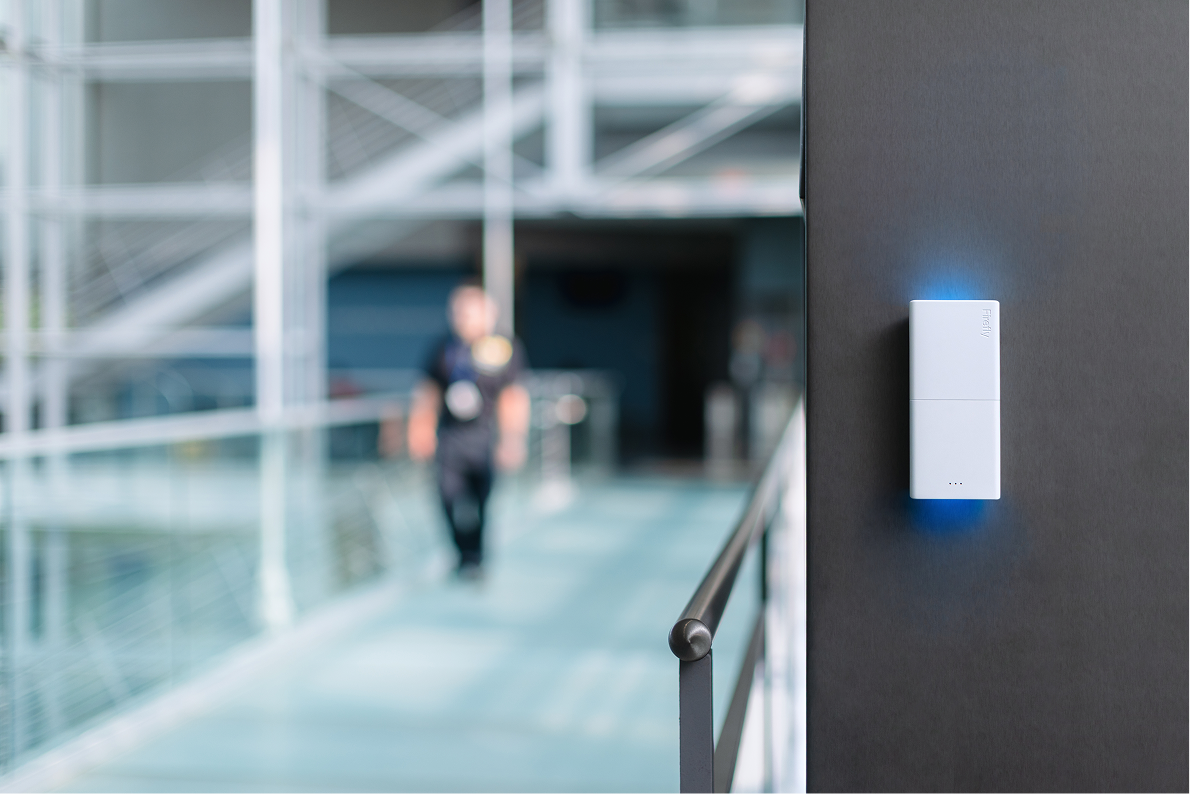 Step 03 · VerifyStep 3. Verify
Context, before chaos.
The alert is enriched with the responder's last known position, the unit's response plan, and the type of incident, before anyone is asked to make a decision. Step 04 · BroadcastStep 4. Broadcast
The right team, not all of them.
Firefly routes the message to the right responders by unit, by time of day, by incident type — security, charge nurse, code response, behavioral health team — and can lock doors, broadcast over speakers, and notify Slack, Teams, radio, and more. Step 05 · ActionStep 5. Action
Hands free, eyes up.
Responders move with a clear instruction set, a live operating picture, and a clean log. The clinician who pressed the button gets steady feedback the entire time — even if they can't look down at the device.

In a hospital, the gap between alert
and action is where things go wrong.
Firefly helps staff trigger a response that is confirmed, located, and routed with far less confusion — across staff duress, visitor incidents, and behavioral health.
And because the system runs on its own mesh, it keeps working when Wi-Fi or power don't.
What happens next is Firefly.
- 01
Staff duress
A discreet wearable for nurses, techs, and physicians. The first move is silent, not a public alarm.
- 02
Visitor and behavioral incidents
Different routing for different incidents. Behavioral health team for one, security for another, code response for a third.
- 03
Off-site and visiting staff
Home-health visits, outpatient sites, in-transit teams. The button works the same. The response adapts.
- 04
Resilient when the building isn't
If Wi-Fi has a bad day or power goes down, the panic button system should not join it. Firefly's mesh keeps running.
The button is the input.
The response is our product.
- Routes by
- Site
- ED. ICU. Med-surg. Behavioral health. Outpatient. Parking.
- Time of day
- Day shift. Night shift. Weekend skeleton crew.
- Incident type
- Staff duress. Visitor escalation. Behavioral. Code response.
- Response plan
- Security. Charge nurse. Behavioral team. Off-site dispatch.
The first seconds
are not the time
for guesswork.
Firefly gives clinical teams a faster, clearer path from alert to action — even when the building is having a bad day.